
Why Spiders Come Inside Every Fall in Central Illinois
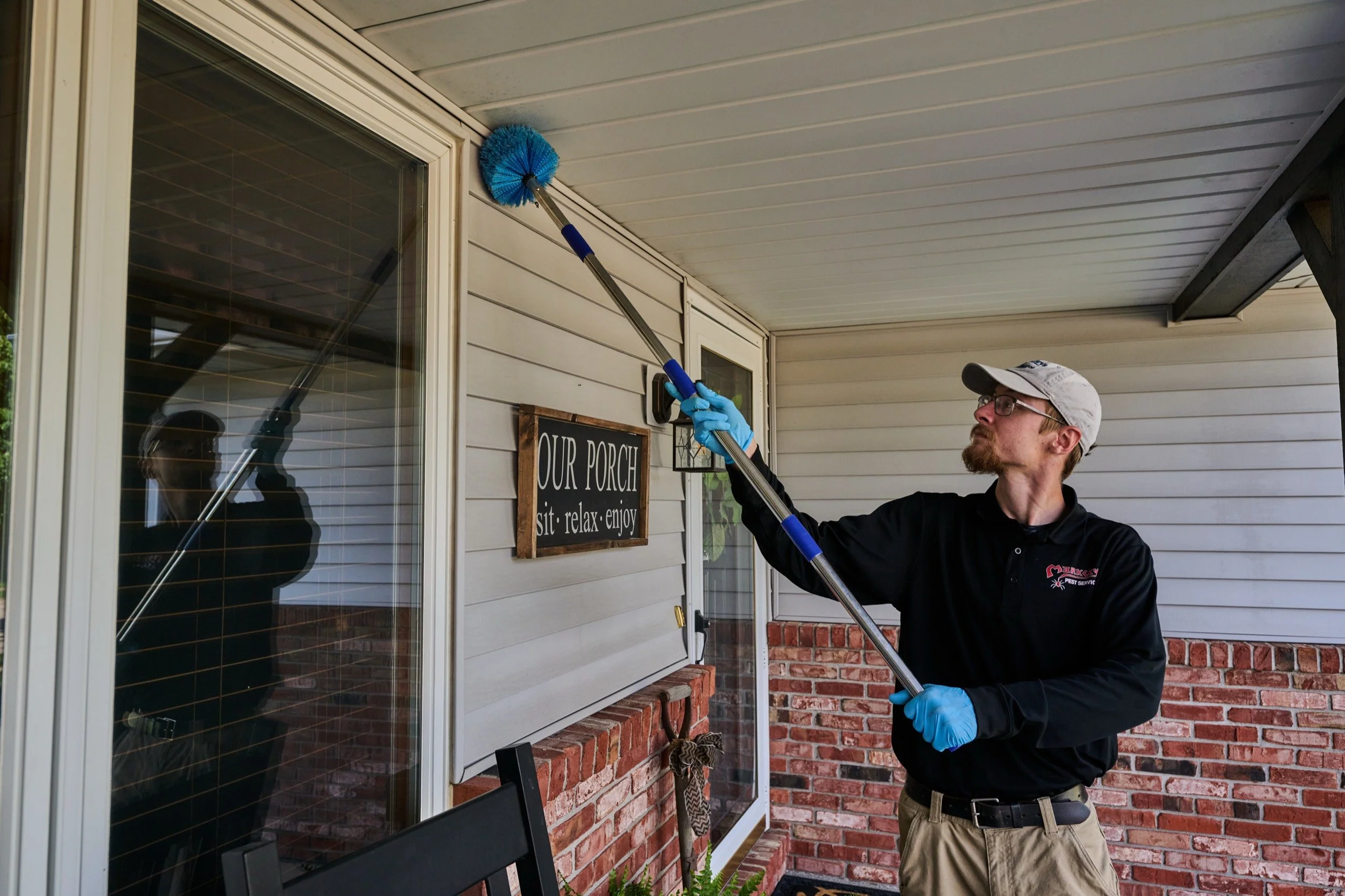
Markley’s clears and treats a porch ceiling in the Peoria area. Knocking down webs and treating the corners where they form is what keeps spiders from rebuilding in the same spot.
It starts around the first week of September. A big one crosses the living room floor at nine at night. There is a web in the corner of the garage that was not there yesterday. Something scurries when you move a box in the basement.
If you live in Peoria, Morton, Washington, or anywhere across the Tri-County area, you know the pattern. What almost everyone gets wrong is the reason.
The Cold Weather Myth
The common explanation is that spiders come inside in the fall to escape the cold.
That is mostly not true, and it is worth knowing why.
Most of the spiders you find in your house are house spiders. They are indoor species. They hatched inside, they have lived their whole lives inside, and they were in your home in July too. You just were not seeing them.
What actually changes in the fall is that it is mating season. Male spiders that have spent their lives tucked into a quiet corner start wandering in the open looking for females. They cross floors. They get caught in bathtubs. They walk across the wall while you are watching TV.
The spider population in your house did not spike. The visible portion of it did.
The one real exception is the larger outdoor hunting spiders, which do wander indoors in fall and will come through any gap they find at ground level.
The Spiders You Actually See Around Peoria
Common house spiders build the messy, tangled webs in ceiling corners, window frames, and basement joists. Harmless, and the most likely thing you are looking at.
Cellar spiders, the ones everyone calls daddy long-legs, hang upside down in loose webs in basements and crawl spaces. Also harmless, and they eat other spiders.
Wolf spiders are the ones that genuinely startle people. Large, hairy, fast, and they do not build webs at all. They hunt on the ground, which means they come in under doors and through gaps at the foundation. They look alarming and they are not dangerous, but a wolf spider crossing your floor at speed will get your attention.
Grass and funnel weavers build the sheet webs with a funnel in the corner that you see all over shrubs and window wells on a dewy morning.
The Two Worth Knowing About
Central Illinois does have two spiders that matter medically, and both are far less common in homes than the internet suggests.
Black widows are glossy black with the red hourglass underneath. They like undisturbed, protected spots: woodpiles, crawl spaces, the underside of outdoor furniture, the back of a cluttered garage shelf. They are shy and they do not chase people. Most bites happen when someone puts a hand into a space without looking.
Brown recluses do occur in Illinois, more commonly downstate than up here. They are uniformly tan with a darker violin shape behind the head, and they have six eyes instead of eight, though nobody is checking that on a live spider. They also prefer undisturbed clutter: storage boxes, seldom-worn shoes, behind furniture that never moves.
Warning: Do not diagnose a spider bite from the internet. Bites from both of these are far rarer than people assume, and a very long list of ordinary skin infections gets misidentified as a recluse bite every year. If you have a wound that is spreading or worsening, see a doctor rather than a search engine.
Spiders Are a Symptom, Not the Problem
This is the part that actually changes how you deal with them.
Spiders are predators. They set up where the food is. A house with a lot of spiders is a house with a lot of insects, and the spiders are simply the most visible evidence of it.
Which means spraying spiders on sight is treating the symptom. Reduce what they are eating and the spiders leave on their own, because there is no reason to stay.
Tip: Look at your exterior lighting. A bright white porch light pulls in moths, midges, and flies all night, and the spiders set up shop right where the food is landing. Switching to a warm-toned or yellow bulb, or moving the light away from the door, cuts the insect traffic noticeably.
What Actually Reduces Spiders
Seal gaps around doors and windows, and check that door sweeps make contact.
Repair torn screens, including basement and crawl space vents.
Knock down webs regularly, inside and out. It is tedious, and it works, because a spider that has to keep rebuilding usually relocates.
Cut back shrubs, ivy, and tall grass touching the house.
Move woodpiles away from the foundation and up off the ground.
Clear clutter in garages, basements, and closets, which is where the two species you would rather avoid prefer to live.
Deal with the insects. A perimeter treatment that reduces the food supply does more for a spider problem than anything aimed at the spiders themselves.
When to Call Markley's
If you are seeing spiders faster than you can deal with them, or you have found something you would rather not identify yourself, that is worth a professional look.
Our general pest service treats the perimeter, the entry points, and the insects the spiders are feeding on, which is the part that actually keeps them from coming back. We serve Peoria, East Peoria, Morton, Washington, and the wider Tri-County area with local, licensed technicians and honest, no-pressure recommendations. More than 2,500 Tri-County families trust us.
Take Your Basement Back
Fall spider season is predictable, which means it is manageable. Markley's has protected Central Illinois homes since 1984.
✔ Free inspections
✔ Local, experienced technicians
✔ Family-safe treatments
✔ No-pressure recommendations
Call (309) 263-0341 or request your free inspection online today.
