
Carpenter Ants vs. Termites: How to Tell What You Actually Have
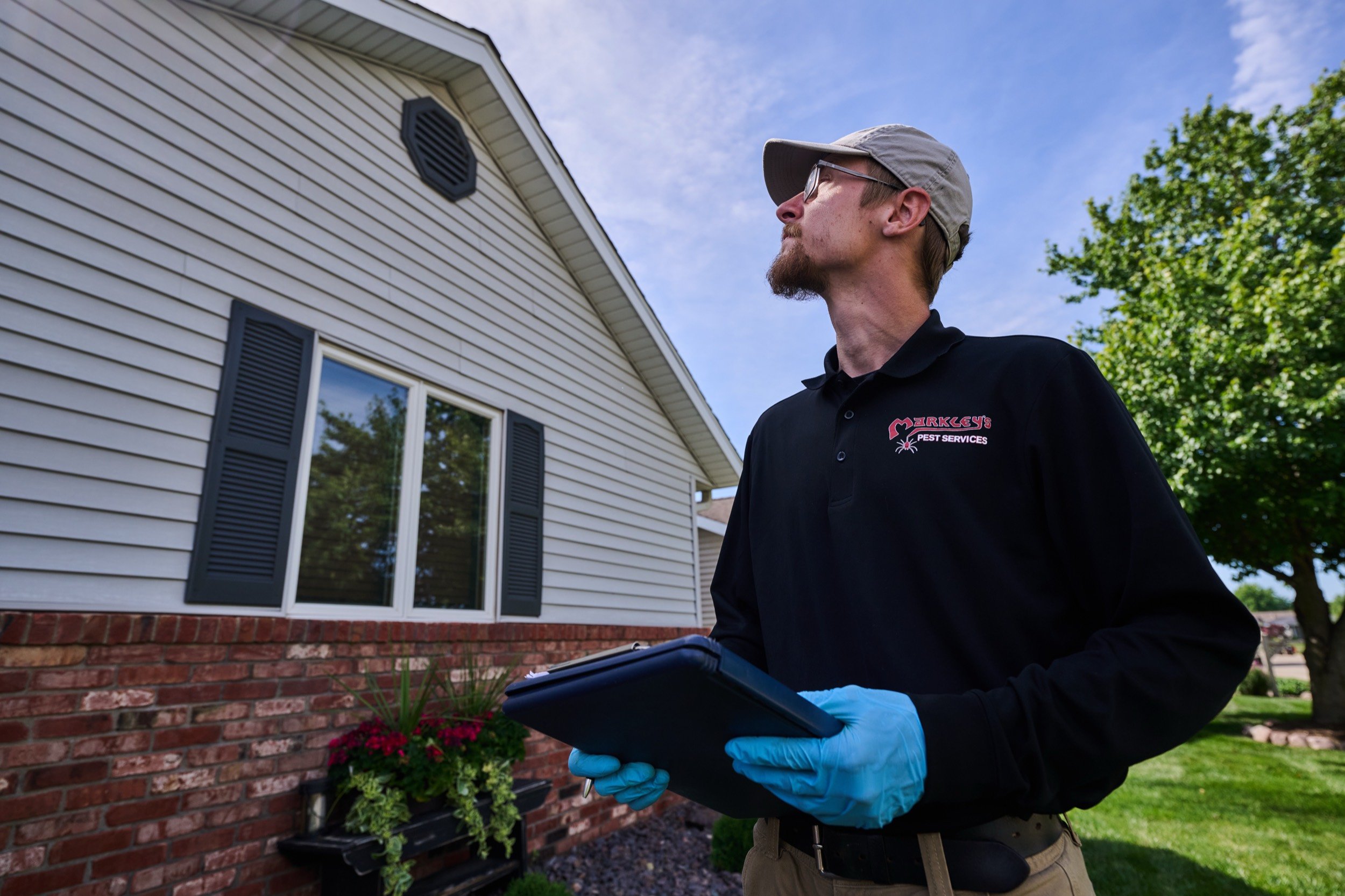
A Markley’s technician inspects a Central Illinois home. Telling carpenter ants from termites correctly is what determines the entire treatment plan.
You find a small pile of what looks like sawdust on the basement floor. Or a scatter of discarded wings on a window sill. Or you press a screwdriver into a floor joist and it goes in further than it should.
Two very different insects produce those symptoms, and the answer changes everything about what happens next.
Why Guessing Wrong Is Expensive
Carpenter ants and termites both damage structural wood, so people treat them as roughly the same emergency. They are not remotely the same problem.
Carpenter ants are usually telling you about a water problem. Termites are telling you about a soil contact problem. The treatments share almost nothing in common, and a treatment aimed at the wrong insect does not slow the right one down at all.
Meanwhile the damage keeps accumulating. So it is worth ten minutes to get the identification right.
If You Can See the Insect
When you have an actual specimen, three features settle it:
Antennae. Ant antennae are elbowed, with a distinct bend partway along. Termite antennae are straight, and look like a tiny string of beads.
Waist. Ants have the pinched, hourglass waist you would draw from memory. Termites have a broad waist and look like a single tube from front to back.
Wings. This is the reliable one during a swarm. A winged ant has front wings noticeably longer than the back pair. A winged termite has four wings all the same length, usually much longer than its body, and they detach very easily.
Color helps a little. Carpenter ants in this area are typically large and black, sometimes with a reddish section. Termite workers are small, pale, and soft-bodied, and look almost translucent.
If You Can Only See the Damage
Most of the time you never see the insect. The damage still tells you.
Carpenter ants do not eat wood. They excavate it to nest in, and they push the debris out. That gives you two distinctive signs: galleries that look smooth and sanded, almost polished, and small piles of frass below. Frass looks like coarse sawdust, and if you look closely it also contains insect body parts and bits of dead ants. That pile is the giveaway.
Termites do eat the wood. Their galleries run with the grain and are packed with mud and soil, dirty rather than clean. And critically, termites produce no sawdust at all. Nothing gets pushed out.
Tip: The sawdust test is the fastest one a homeowner can run. Debris accumulating below the damage means carpenter ants. A hollowed joist with nothing underneath it means you should be thinking about termites.
The Other Signs That Separate Them
Mud tubes running up a foundation wall, pier, or joist are termites, full stop. Carpenter ants never build them.
Rustling or faint crackling inside a wall at night, loudest after dark, points to a carpenter ant nest. They are most active in the evening.
Discarded wings happen with both, but termites in Central Illinois swarm in spring, and the wings pile up on sills and in spider webs near the swarm point.
Trails of large black ants along a foundation, deck rail, or tree limb touching the house, especially at dusk, means look for the nest.
What Each One Is Telling You About Your House
This is the part that matters more than the identification itself.
Carpenter ants nest in wood that is already damp or decaying. They are much more likely to move into a leaking window frame, a sill plate under a bad gutter, a bathroom subfloor with a slow leak, or a porch column that sits in standing water. When we find carpenter ants, we are usually also finding a moisture problem, and treating the ants without fixing the water gets you the ants back.
Termites need contact with soil, because they need moisture from the ground and they build their tubes to bridge from soil to wood. That points at grade level: wood-to-soil contact, mulch piled against siding, a porch slab, foundation cracks.
For much more on the termite side, including how colony elimination works, see our post on year-round termite protection with Sentricon. For more on carpenter ant behavior, see our earlier guide to what homeowners need to watch for.
Warning: A can of ant spray from the hardware store kills the ants that walk through it and does nothing to the nest, which may be inside a wall on the other side of the house. Carpenter ant colonies also establish satellite nests, so killing the ones you see can leave the main colony untouched.
The Treatments Are Not Interchangeable
For carpenter ants, the work is locating the nest, which is frequently not where you are seeing the ants, treating the colony directly, and identifying the moisture that made your wood attractive in the first place.
For termites, the work is eliminating the colony in the soil. That is why we install the Sentricon system: foraging termites take the bait back and share it, and the colony eliminates itself, rather than being repelled to some other part of the structure.
Nothing about those two approaches overlaps. Which is exactly why the identification comes first.
When to Call Markley's
If you have found damaged wood and you are not certain what caused it, do not guess and do not wait. Either answer gets worse with time.
An inspection for ants and general pests is free. If what we find points to termites, a full termite inspection is $120, and that amount goes toward the cost of treatment if you have termites and choose to move forward with us.
We serve Peoria, East Peoria, Morton, Washington, and the wider Tri-County area with local, licensed technicians and honest, no-pressure recommendations. More than 2,500 Tri-County families trust us.
Find Out What You Are Dealing With
Damaged wood does not repair itself, and the two likeliest causes need opposite solutions. Markley's has protected Central Illinois homes since 1984.
✔ Free inspections for ants and general pests
✔ $120 termite inspection, credited toward your treatment
✔ Local, experienced technicians
✔ No-pressure recommendations
Call (309) 263-0341 or schedule your inspection online today.
