
Why Yellowjackets Turn Aggressive in Late Summer
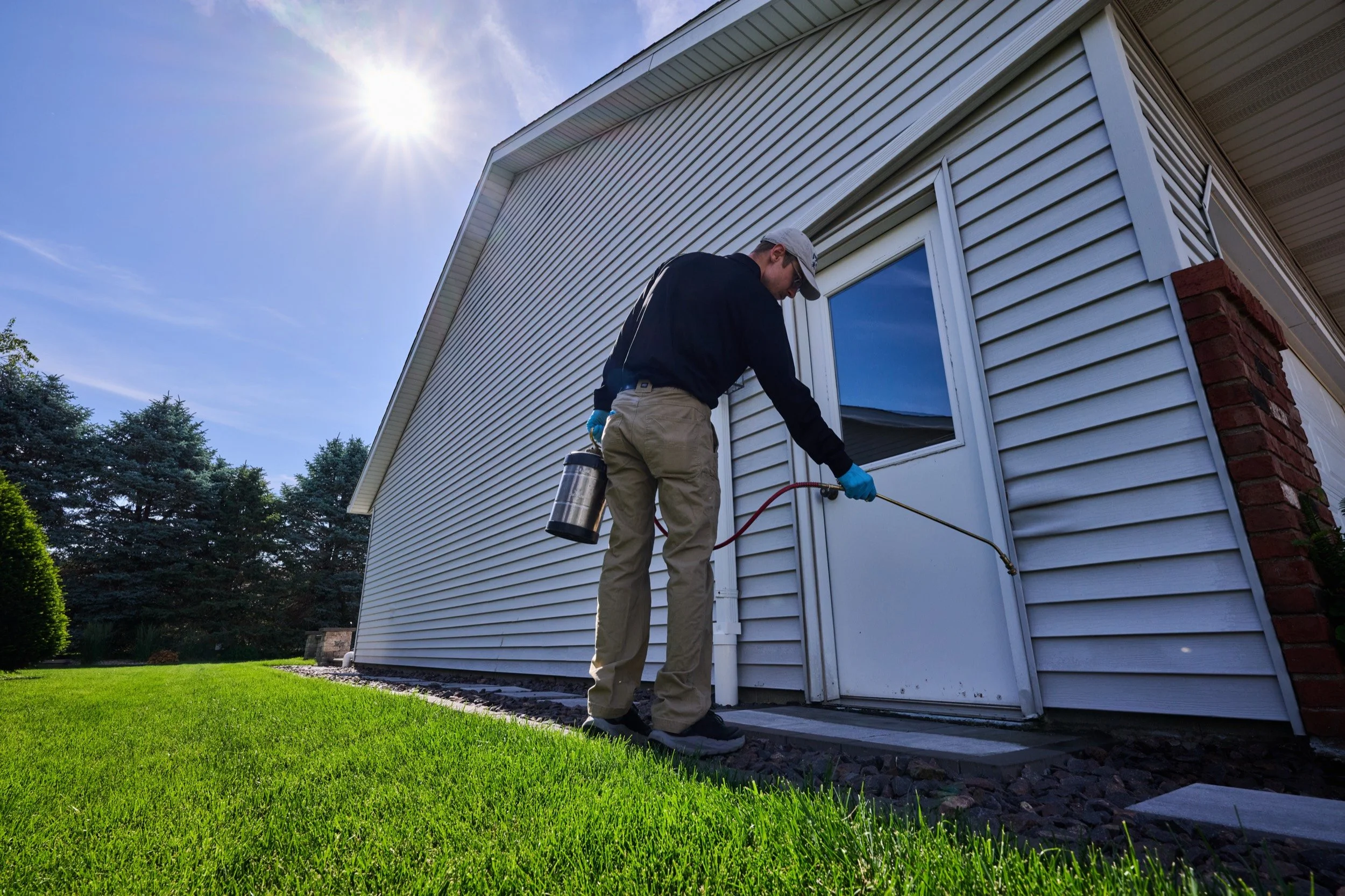
Markley’s treats the exterior of a Peoria-area home. Yellowjackets often nest inside wall voids, entering through small gaps around siding, trim, and window frames.
Every year it happens the same way. You get through most of the summer barely noticing wasps, and then around the middle of August they are everywhere. In the trash can. Hovering over the potato salad. Landing on the rim of a pop can.
If you live in Peoria, Morton, Washington, or anywhere across the Tri-County area, this is not bad luck and it is not your yard. Two things happen to yellowjacket colonies in late summer, and together they explain everything you are seeing.
They Have Been Building All Year
A yellowjacket colony starts every spring with a single queen. One insect, working alone, building a nest the size of a golf ball.
By late summer that same nest can hold thousands of workers.
The colony has been growing all season without you noticing, because for most of the summer the workers are busy hunting insects to feed the young back at the nest. They are out in your yard, but they are working, and they have no reason to care about you.
That changes in August.
The Diet Switch That Puts Them at Your Table
Here is the part almost nobody knows. Yellowjacket workers spend the summer catching protein, caterpillars, flies, spiders, and carrying it back to feed the larvae. In exchange, those larvae produce a sugary secretion that the adult workers feed on.
In late summer the queen stops laying. The larvae finish developing. And suddenly thousands of adult workers lose their food supply at the same moment.
So they go looking for sugar somewhere else. Fallen fruit under the tree. Hummingbird feeders. Open garbage. Your drink.
That is why yellowjackets seem to develop a personality problem in September. They are not angrier. They are hungrier, there are far more of them than in June, and they have started competing directly with you for the same food.
They Are Not Honeybees, and It Matters
A honeybee stings once and dies, because its stinger is barbed and tears free. A yellowjacket has a smooth stinger. It can sting repeatedly, and it will if it feels the nest is threatened.
Quick way to tell them apart: honeybees look fuzzy and golden brown. Yellowjackets look smooth, glossy, and sharply banded in bright yellow and black, with a narrow waist. If it is shiny and it is interested in your food, it is not a honeybee.
This matters because honeybees are worth protecting and yellowjackets found at a picnic are not a hive worth saving. For a fuller breakdown of what is flying around your property, see our guide to the types of bees and wasps.
Warning: Never plug the entrance of a nest inside a wall void. Yellowjackets that cannot get out the way they came in will chew through drywall to escape, and they will do it into your living room instead of your yard.
Where They Nest Around Central Illinois Homes
Yellowjackets are not picky, and the nest is usually somewhere you would not think to look:
Underground, very often in an abandoned rodent burrow, with nothing visible but a steady stream of insects going in and out of a hole in the lawn.
Inside wall voids and attic spaces, entering through a gap in siding or trim.
Under soffits, deck boards, and porch ceilings.
In sheds, grills that have not been used in a while, and stacked landscape timbers.
Tip: If you suspect a ground nest, watch the lawn from a distance around dusk and look for the traffic pattern. Mark it with a stake several feet away. Do not stand directly over the opening to get a better look.
The Mistakes That Get People Stung
Most late-summer stings in this area come from a handful of predictable situations:
Running a mower over a ground nest. The vibration alone will bring the colony out, and you are standing right there.
Spraying a nest in the middle of the day. That is when the most workers are out foraging, and they come home to a disturbed nest with you still nearby.
Knocking a nest down. This does not remove the colony. It scatters it.
Pouring gasoline or bleach down a ground nest. This contaminates your soil and groundwater, it is genuinely dangerous, and it frequently does not kill the colony.
Swatting at one that lands on you. Crushing a yellowjacket releases an alarm signal that recruits others.
They Do Die Off. That Is Not Always Good Enough.
Here is the honest part. A yellowjacket colony is annual. The first hard freeze kills the workers, and only newly mated queens survive to start over somewhere else next spring. The nest is never reused.
So if a nest is out at the back of the property, away from where anyone walks, waiting it out is a legitimate option.
But if the nest is near a door, over a walkway, in the wall of the house, or anywhere kids or pets play, September and October are the worst possible weeks to wait. That is when the colony is largest and most defensive. And if anyone in your household has a sting allergy, this is not a wait-and-see situation at all.
When to Call Markley's
Wasp and hornet nests are one of the few pest problems where the do-it-yourself attempt genuinely puts you in the hospital. We remove them with the right protective equipment, at the right time of day, and we treat the nest itself rather than the insects flying around it.
We serve Peoria, East Peoria, Morton, Washington , and the wider Tri-County area with local, licensed technicians and honest, no-pressure recommendations. More than 2,500 Tri-County families trust us.
Get the Nest Handled
You should be able to eat outside in September. Markley's has protected Central Illinois homes since 1984.
✔ Free inspections
✔ Local, experienced technicians
✔ Family-safe treatments
✔ No-pressure recommendations
Call (309) 263-0341 or request your free inspection online today.
